Rigdon Huston Blandinsville #19
Rigdon Huston came from one of the early pioneer families of Illinois. The
Hustons first lived in Virginia before moving to White County, Tennessee, and
then on to McDonough County during the early days of Illinois settlement.
Rigdon was born here on October 27, 1833, making him a true son of
McDonough County.
Not much has been written about his younger years. He was one of eight
children born to John and Anna Melvin Huston, but the records and stories he
left behind paint the picture of a hardworking man who was satisfied to spend
his life right here at home while still leaving a lasting mark on the county.
In 1854, at only 21 years old, Rigdon helped settle the estate of his
grandfather, John Huston, serving as executor along with William Berry. By
then, the Huston family already had deep roots in the county and owned
valuable land in the area.
On December 24, 1857, Rigdon married Caroline Charter. Caroline was the
daughter of Jonathan and Nancy Ward Charter. Sadly, her father had passed
away only a month before the wedding.
By the time of the 1860 Federal Census, Rigdon and Caroline were building
both a family and a successful farming operation. Their oldest son, Theodore,
was just a year old, and another son, James Allen, would be born later that
same year. Caroline’s younger brother and sister, Harrison and Laura Charter,
were also living in the household. The young couple had already accumulated
real estate worth $9,000, a considerable amount for the time.
Over the next decade, the Huston cattle business grew quickly. The 1870
census showed Rigdon and Caroline raising four sons — Theodore, James
Allen, Charles Rigdon, and John Henry. Three young hired men also lived on
the farm, likely helping with the cattle work. By then, the family’s land holdings
were valued at $55,000, showing just how successful the operation had
become. The last Huston child, Louella Huston (Mrs. Charles Lambert
Blandin) was born in 1879.
Rigdon was not only known for his cattle business, but also for serving his
community. During the 1870s, he served as a petit juror, sat on the Board of
Trustees for Abingdon College, served on the McDonough County Board of
Supervisors, and helped with the county’s Centennial Celebration Committee
in 1876.
By the late 1870s, the Huston name had become well known in cattle circles.
Histories of McDonough County praised the cattle raised by Rigdon and his
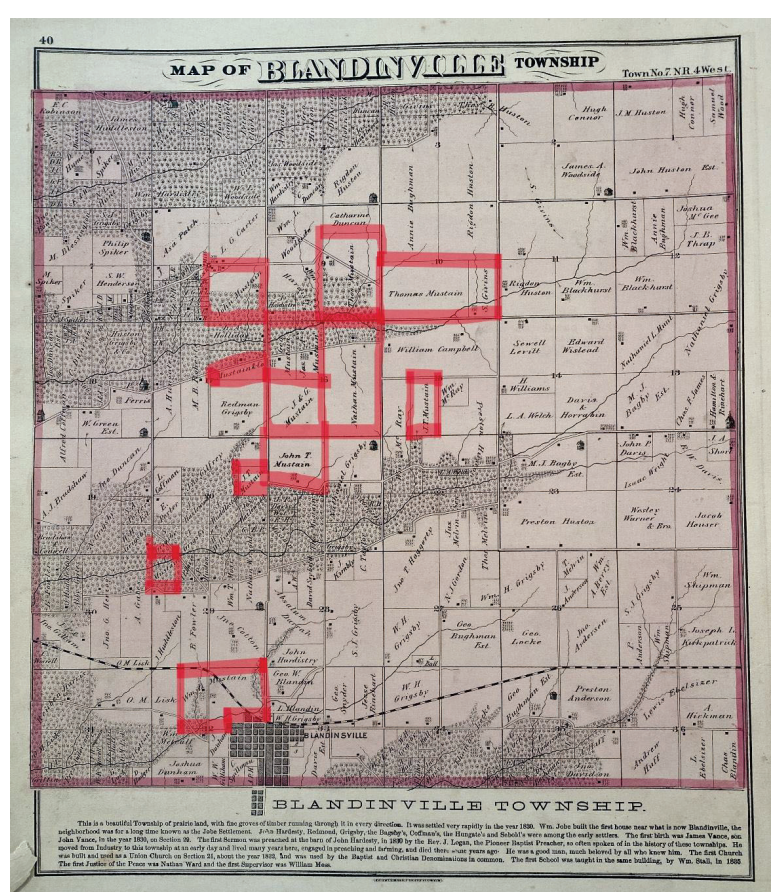
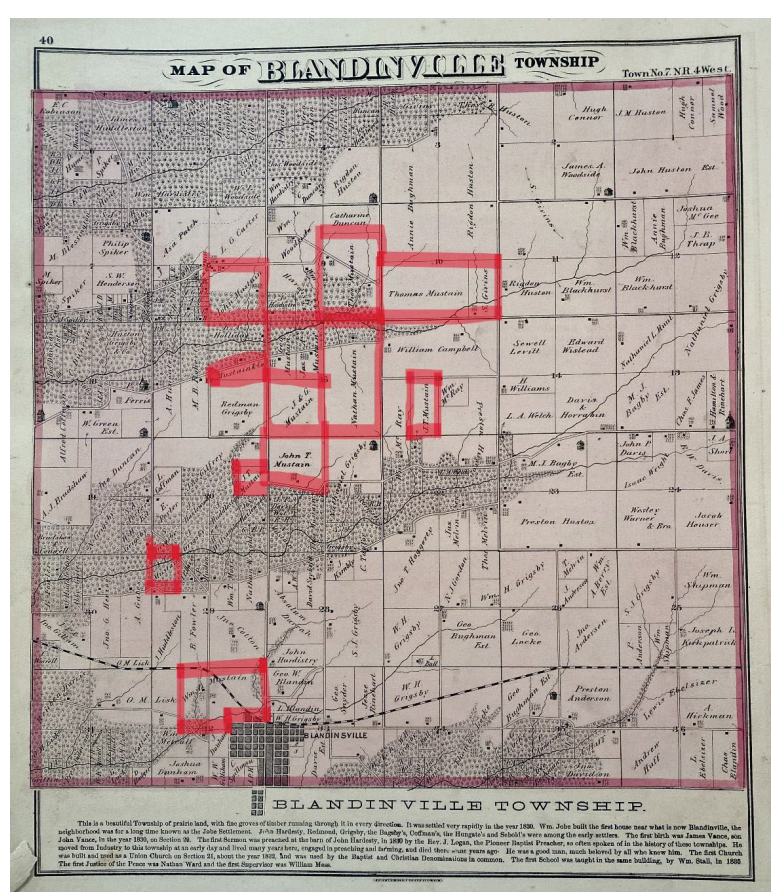
son. Their operation, known as Hilldale Stock Farm, covered 1,250 acres in
northeastern Blandinsville Township. The farm specialized in Durham
Shorthorn cattle, one of the finest breeds of the day. Writers of the time
claimed that “no man was better versed in cattle lore” than Rigdon Huston.
The Hustons owned 127 head of registered cattle, and some animals were
valued at astonishing prices. In fact, one history book recorded that in 1881
Rigdon Huston & Son made what was said to be the largest private cattle
purchase in the United States up to that time. They paid Colonel LeG. Cannon
of Vermont $50,000 for 32 head of prized Shorthorn cattle, including several
animals of famous bloodlines.
After a life spent building cattle herds and serving his neighbors, Rigdon
Huston died in the same county where he had been born on May 17, 1887.
Caroline outlived him by another 27 years. Just a year after Rigdon’s death,
she found herself in court fighting a Bloomington insurance company that
refused to pay on his life insurance policy. Even after his passing, the Huston
name continued making news in McDonough County.
Pioneers of the Past is furnished by Julie L. Terstriep, of the McDonough County
Genealogical Society, facebook.com/mcdcgs. For more Pioneers of the Past, go to
https://www.mcdcgs.com/pioneers-of-the-past/
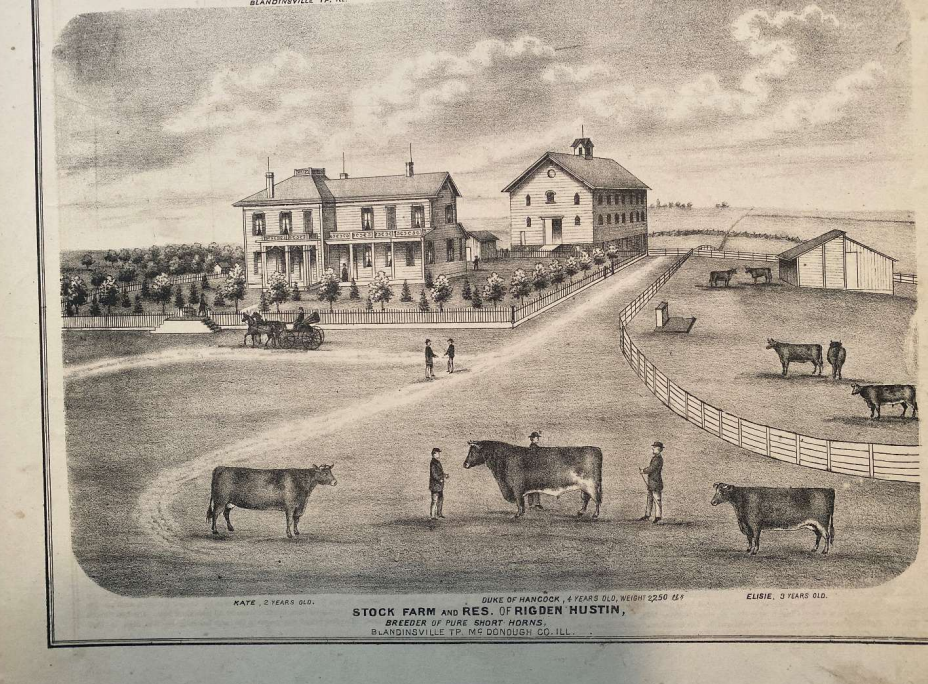
the fine cattle he raised. Huston’s farm was called Hilldale Stock Farm and
was known far and wide for it’s Durham Shorthorn cattle.