Captain O. M. Lisk #16

Captain O. M. Lisk is buried in Blandinsville Cemetery, far removed from the
rivers that once defined his early life. His journey from canal boats to the
farms of McDonough County reflects a broader 19th-century pattern of
migration, adaptation, and reinvention.


Orra Metcalf Lisk was born near Cooperstown, New York, in 1819. His early
years were spent working on a canal boat, where he first learned the rhythm of
water travel and westward movement. As a young man, he walked to Marion,
Ohio, where he worked on a farm for $8 per month before continuing west with
his father to Monmouth, Illinois.


From there, Lisk’s life took a more maritime turn. In St. Louis, he encountered
a former neighbor who captained a diving bell boat. Lisk joined the crew,
eventually investing in the steamboat itself and earning the lifelong title of
“Captain.” For several years, he worked the Mississippi River trade between St.
Louis and New Orleans, a region defined by commerce, risk, and constant
movement.


His life was not without violence. In 1851, Lisk was nearly killed when Horace
Smith, an acquaintance, shot him during a dispute described in contemporary
accounts as being of a “very delicate nature.” The bullet remained lodged in
his shoulder, though he survived the injury.


Genealogical records, including Find A Grave, report that Lisk married Olive
Andrews Kingsley Littlefield in New Orleans in 1849. Olive’s earlier life was
complex and marked by multiple marriages and separations. She had married
Samuel Kingsley in 1838 and later Lyman Littlefield in Adams County, Illinois,
in 1840. That union ended in separation in 1846. Olive and Lisk later separated
as well.


The 1860 U.S. Federal Census places O. M. and “Olivia” Lisk together with two
daughters: Dorina (or Donna) Littlefield, born in Louisiana in 1844, and Kate,
born in 1852. Lisk’s elderly mother, Nancy, age 78, also lived in the household.
Olive and Orra would eventually go their separate ways.


A new chapter began in 1868 when Lisk married his cousin, Helen Metcalf, in
Michigan. The couple relocated to McDonough County, establishing their
home in Blandinsville. Together, they had two sons, Louis H. and Guy Metcalf
Lisk, further anchoring the family in western Illinois.


By 1870, the census records reflect a full household: Orra, age 51; Helen, age
30; Kate, age 18; Louis, age 1; and Nancy Lisk, age 84. Lisk’s holdings included
$26,000 in real estate and $3,500 in personal property, placing him among the
more substantial landholders in the area.


After years devoted to farming and civic life, the Lisk family settled into the
Blandinsville community. Local newspapers frequently referred to him as
“Captain Lisk,” a title that followed him from his river years into rural Illinois.
He was respected locally and often called upon to serve on juries.


Helen Lisk died in 1895. Orra Metcalf Lisk died in 1904 at the age of 84, closing
a life that spanned canal boats, steamboats, frontier towns, and the settled
farms of McDonough County.

THANK YOU to Lori Boyer who so freely shared her extensive research on O.
M. Lisk and brought the captain to my attention.

Pioneers of the Past is furnished by Julie L. Terstriep, of the McDonough County
Genealogical Society, facebook.com/mcdcgs. For this story, go to
https://www.mcdcgs.com/pioneers-of-the-past/
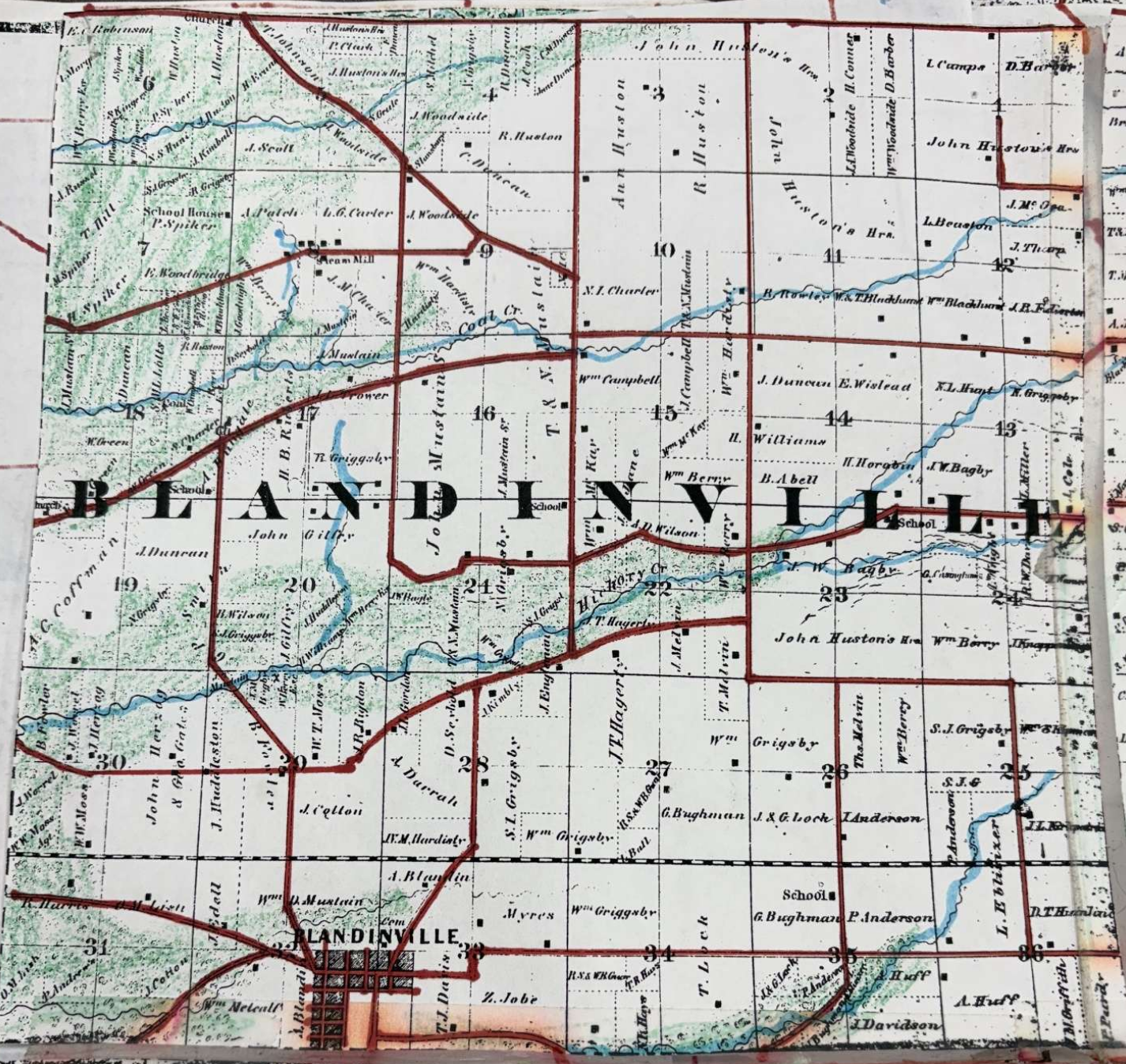
From the 1871 Atlas Map of McDonough County, Illinois

Stephen A. Hendee #17

In the Bushnell cemetery, a large gray granite stone marks the resting place of
Stephen A. Hendee. Stephen’s life reads like an adventure book full of
interesting places and people and business success. His story starts in what
is known as the “Quiet Corner” of Connecticut – Windham County.
Stephen A. Hendee, son of Amasa Hendee and an unknown wife. Stephen’s
father and stepmother came to the area in 1838 when they settled at
Halkental’s bridge on the Spoon River. It’s here where Stephen learned his
first trade of a miller. By 1850, new occupations called and Stephen moved to
Lewistown and lived with the Joel Solomon family and worked as a clerk in his
mercantile store.


As an adventurous young man, Stephen had no doubt read about the great
Gold Rush in California. He set oƯ in 1852 ready to make his fortune. During
his years in California, he eventually worked for Wells Fargo Express for a year.
According to a county history, he then went to Central America where he
stayed for four months. Whatever it was he was looking for, he didn’t find it
and return to Lewistown where he bought out the stock of Nathan Beadles
mercantile. Beadles became an important person in his life as evidenced by
the fact that three of his children had Beadles in their own name.


Hendee opened a mercantile in Marietta in 1854, then Bardolph in 1856. In
1858, he began a new business operation when he married Sarah Groendyke.
Just two years later, the Hendees had moved to Bushnell and he joined Wilson
& Company Mercantile. By the age of 29, Stephan A. Hendee was worth
$3,500 in real estate alone. He ran for county judge in 1861 as a Republican
and his business success continued as he branched out of the mercantile.


The 1870 US Federal Census show Stephan A. Hendee with real estate worth
$20,000 and personal property worth $15,000. His businesses had grown
considerably in just ten years. As their children were born, Sarah’s parents
moved in next door to them and Stephen and Sarah’s daughter, Adrianna, was
named after her grandmother, Adriana Nevius Groendke.


An 1878 county history names several businesses and buildings with
Hendee’s name on them. Hendee House on West Main Street in Bushnell was
listed as one of the finest hotels in the area. There were nine grain elevators
Stephan A. Hendee and his business partner, D. F. Chidester owned. Hendee
owned a grocery store, a dry goods store, and there was a city block named
“Hendee Block” which housed several attorneys and at least one dentist in
Bushnell.


The Hendees had six children: Luan Beadles Hendee – Mrs. Clarence Clarke;
Adrianna G. Hendee Hicks – Mrs. Fred Hicks, Leo Nathan Hendee, Nathan
“Nick” Beadles Hendee, Edgar Hendee, and Fanny Grey Hendee Roach – Mrs.
Albert “Bert” Roach. Sarah Groendyke Hendee died in 1893 and Stephen
followed in 1910.


Sarah died in 1893 and Stephen in 1909 at the age of 81 after being bedridden
for 15 months. The Macomb Daily Journal ran a story that his will had been
filed and his estate was valued at $125,000 which included several grain
elevators, farms and 3,600 acres of land in Dawson County, Nebraska.


Stephen A. Hendee was a Yankee entrepreneur of his day and he left quite a
mark on Bushnell, Illinois.

Pioneers of the Past is furnished by Julie L. Terstriep, of the McDonough County
Genealogical Society, facebook.com/mcdcgs.

Jonas Hobart, Revolutionary War Veteran #15

In one of the southeastern cemeteries of McDonough County stands a white
military marker inscribed: “Corpl. Jonas Hobart, 1 N.H. Continentals, Rev.
War.” It marks the grave of a New Hampshire soldier who carried the scars—
and the memory—of the American Revolution to the Illinois frontier.


Jonas Hobart was born in November 1744 in Groton, New Hampshire, the
third of ten children of Shebuel Hobart and Esther Park. In 1770, he married
Elizabeth “Betsy” Kemp. After learning of the death of his younger brother
Isaac was killed at the Battle of Bunker Hill, Jonas resolved to take his place.
At age 32, he enlisted on March 17, 1777, serving as a corporal in the 4th
Company, 1st New Hampshire Regiment of the Continental Army.


That summer, Jonas served under General Philip Schuyler during the
campaign at Fort Ticonderoga. During the fighting—or possibly the retreat—he
was struck by a musket ball that entered his right cheek, knocked out two
teeth, and lodged near his left collarbone. The bullet was removed with a
pocketknife, and both it and one of the teeth have been preserved by a
descendant.


Jonas remained in service until his discharge on January 1, 1781. Decades
later, in 1818, while living in St. Albans, Vermont, he applied for and received a
pension of $96 per year for his service.


Around 1822, seeking better prospects in his later years, Jonas and Betsy
joined family members traveling west by covered wagon. They arrived at
Downings Landing (present-day Beardstown, Illinois) on February 22, 1823.


After a brief stay in Schuyler County—where their granddaughter Ruth Powers
took part in the county’s first recorded marriage—the family settled in
McDonough County. There, Jonas purchased five acres in Eldorado Township.
Corporal Jonas Hobart died on December 15, 1833. Betsy followed a year
later.


Hobart is one of four Revolutionary War soldiers buried in McDonough County.
As the nation approaches its 250th anniversary, this series will highlight each
of these Patriots who carried the legacy of the Revolution into the early days of
the Illinois frontier.


Pioneers of the Past is furnished by Julie L. Terstriep, of the McDonough County
Genealogical Society, facebook.com/mcdcgs. For this story, go to
https://www.mcdcgs.com/pioneers-of-the-past/

Lewis and Elizabeth Eblesizer #14

Lewis Eblesizer (1818–1887) came into the world in Indiana, the son of Adam Ebelsizer and Polly Baker. Life dealt him a hard hand early—his father died when Lewis was just three years old, and before long his mother married again, to Isaac Murphey.

When Lewis reached manhood, he did what a good many young fellows were doing in those days—he struck out west in search of something better. In 1839, he left Indiana in the company of Andrew Huff and Jacob Keithly. The three made their first stop in Rushville, Illinois, where they set up a plow shop and put their hands to honest work.

But they didn’t stay put for long. Around 1844 or 1845, the trio moved on again, this time settling in Blandinsville Township when the country was still young and needed improving.

Lewis was still single then and made his home with Andrew Huff. The two men fell into the steady pattern of pioneer life—working their land through the warm months, then turning to blacksmithing when winter set in. It was a hard way to make a living, but a dependable one.

In 1846, Lewis married Elizabeth Jane Nance, a young woman from LaHarpe . Together they built a life and, in 1854, welcomed their only child, a son they named Columbus.

Years passed, and by the time of the 1860 Federal Census, the old neighbors were still side by side—Lewis and Andrew Huff living next to each other, just as they had from the start. An 1864 tax record shows Lewis earning $485, with a tax of $14.55—not a fortune by any means, but enough to get by and keep things going.

Lewis and Elizabeth stayed rooted in the Blandinsville area all their days. Lewis passed on in 1887, and their son, Columbus, followed in 1896 at the age of 42, leaving no children behind.

Elizabeth lived on. In 1906, she had a house built on her lots along Pierce Street in Blandinsville , where she spent her remaining years. When she died in May of 1912, she made careful plans for what she left behind. Her home went to her brother, Absolom Nance, while the rest of her estate was set aside in trust to care for her husband’s resting place in .

There had been more money at one time—fifty or sixty thousand dollars, according to newspapers of the time—but most of that had already passed to her daughter-in-law, Elizabeth Mustain Eblesizer, through son, Columbus before his death. Elizabeth Mustain Eblesizer, Mrs. Columbus, passed away in 1936 ending the family line.


Pioneers of the Past is furnished by Julie L. Terstriep, of the McDonough County Genealogical Society, facebook.com/mcdcgs. For this story, go to https://www.mcdcgs.com/pioneers-of-the-past/


From the 1871 Plat of McDonough County, the home of Lewis and Elizabeth Nance Eblesizer

Samuel Joseph Foster #13

Foster’s Point sits up in the northeast corner of Eldorado Township, and it
takes its name from the Arthur J. Foster family, who settled there back in 1831.
One of Arthur’s boys, Samuel Joseph Foster—the fourth of five sons—holds
the distinction of being the first white child born in the township.


S. J. grew up to be a farmer, as so many did, and married Mary MacMahan.
Together they raised a big, bustling family of nine children on their 500 acre
farms: Sarah V. (who married William T. Vail), Alonzo D., James M., John
Lemuel, Henry Lincoln, Eva H. (wife of Rev. Henry A. Brown), Nellie Cornelia
(who married William D. Barclay), Luella (wife of Edward Thomas Ausbury),
and Samuel Roy.


Mary passed on in 1910, and not long after, Samuel began turning the farms
over to his sons. He’d done well for himself—his livestock was known all over
the county—but like a lot of farmers, he never did take too kindly to sitting still.
Retirement didn’t suit him much, and before long he was right back at it,
raising stock and making his daily rounds to the farm, keeping an eye on things
just the way he always had.


That went on until his health gave way in 1917. The next year, on November 27,
1918, S. J. Foster passed away at the age of 85.


He left behind quite a legacy. There was still a brother and sister living, along
with twenty-one grandchildren and sixteen great-grandchildren. Three of his
and Mary’s sons even served over in France during the Great War.


Today, a small cemetery at Foster’s Point marks the old home place in
Eldorado Township. Many of the Foster family rest there still, a quiet reminder
of those early days and the folks who helped settle that corner of the county.

Pioneers of the Past is furnished by Julie L. Terstriep, of the McDonough County
Genealogical Society, facebook.com/mcdcgs. For this story, go to

https://www.mcdcgs.com/pioneers-of-the-past/

Daniel M. Crabb #12

Daniel Middleton Crabb came into the world on November 14, 1823, in the
hills of Virginia, the fourth child and oldest son of nine children born to John
and Ann Fleming Crabb. When he was just a boy, the family packed up and
headed west, arriving in McDonough County in November of 1836—back
when the country there was still young and only beginning to be broken to the
plow.


Daniel’s father, John, started out by renting the west half of Section 16 in
Macomb Township for five years. Like so many determined pioneers, he didn’t
stop there. Before long, he began buying land of his own, adding piece by
piece until he held more than 620 acres in the county. When John passed
away in 1865, Daniel received 64 acres —the north part of the southeast
quarter of Section 17 and another part of a farm, ground his father had
worked so hard to gather.


Daniel spent nearly all his days in McDonough County, save for a stretch of
time when he went oƯ to study at the Cincinnati Veterinary College. That
schooling served him well, for he returned home as a veterinary surgeon,
tending to the livestock that were the backbone of every farm, while also
working the land himself.


In 1850, at 27 years of age, Daniel struck out to build a home of his own. He
married Rebecca Hampton of Ohio, and together they began raising a family.
They were blessed with four children—though their fourth, an infant, died at
birth. Their surviving children were Laura E., who later married W. H. King;
Anna, who became Mrs. B. Milling; and a son, James M. Crabb. Sadly,
Rebecca’s life was cut short, and she passed away in 1860.


A couple of years later, in 1862, Daniel married again, taking Mary E. Bards (or
Bardo) as his wife. To them was born one son, Robert Emmet Crabb. Mary
lived a long life, but in a bittersweet turn, she died on March 6, 1902—the very
anniversary of their wedding day.


Not one to spend his final years alone, Daniel married a third time in 1903, at
the age of 80, to Kittie Kline of Macomb. He lived just a few more years,
passing away on May 3, 1906, at the age of 85 years, 5 months, and 20 days,
from carcinoma of the liver. He was laid to rest in the Good Hope Cemetery.
By the time Daniel’s long life came to a close, most of that large pioneer family
had gone before him. Only one brother, R. F. Crabb, and two sisters—Mrs.
Mary Kepple of Bardolph and Mrs. Betsy McCrary of Good Hope—were still
living to remember those early days and the journey that had brought them
west.

1871 Atlas Map of McDonough County


Lewis and Elizabeth Eblesizer #14

Image from the 1871 Plat of McDonough County, the home of Lewis and Elizabeth Nance
Eblesizer

Lewis Eblesizer (1818–1887) came into the world in Indiana, the son of Adam
Ebelsizer and Polly Baker. Life dealt him a hard hand early—his father died
when Lewis was just three years old, and before long his mother married
again, to Isaac Murphey.
When Lewis reached manhood, he did what a good many young fellows were
doing in those days—he struck out west in search of something better. In
1839, he left Indiana in the company of Andrew Huff and Jacob Keithly. The
three made their first stop in Rushville, Illinois, where they set up a plow shop
and put their hands to honest work.
But they didn’t stay put for long. Around 1844 or 1845, the trio moved on
again, this time settling in Blandinsville Township when the country was still
young and needed improving.

Lewis was still single then and made his home with Andrew Huff. The two men
fell into the steady pattern of pioneer life—working their land through the
warm months, then turning to blacksmithing when winter set in. It was a hard
way to make a living, but a dependable one.

In 1846, Lewis married Elizabeth Jane Nance, a young woman from LaHarpe .
Together they built a life and, in 1854, welcomed their only child, a son they
named Columbus.

Years passed, and by the time of the 1860 Federal Census, the old neighbors
were still side by side—Lewis and Andrew Huff living next to each other, just
as they had from the start. An 1864 tax record shows Lewis earning $485, with
a tax of $14.55—not a fortune by any means, but enough to get by and keep
things going.

Lewis and Elizabeth stayed rooted in the Blandinsville area all their days.
Lewis passed on in 1887, and their son, Columbus, followed in 1896 at the
age of 42, leaving no children behind.

Elizabeth lived on. In 1906, she had a house built on her lots along Pierce
Street in Blandinsville , where she spent her remaining years. When she died
in May of 1912, she made careful plans for what she left behind. Her home
went to her brother, Absolom Nance, while the rest of her estate was set aside
in trust to care for her husband’s resting place in.

There had been more money at one time—fifty or sixty thousand dollars,
according to newspapers of the time—but most of that had already passed to
her daughter-in-law, Elizabeth Mustain Eblesizer, through son, Columbus
before his death. Elizabeth Mustain Eblesizer, Mrs. Columbus, passed away in
1936 ending the family line.

Pioneers of the Past is furnished by Julie L. Terstriep, of the McDonough County
Genealogical Society, facebook.com/mcdcgs. For this story, go to

Pioneers of the Past

Captain Charles R. Hume – Hire Township #11

Charles R. Hume packed quite a bit of living into his years. He was born January 1, 1814, in Delaware County, New York, one of ten children of Robert and Catherine Ross Hume. After finishing at Jefferson Academy, he headed west in 1837 to McDonough County, Illinois, where he bought 320 acres in Hire Township. Along the way, the steamboat he was traveling on blew up, injuring several passengers—but Hume came through without a scratch and went right on with his plans.

In 1839, he married Harriet Lucinda Blandin, daughter of Joseph L. Blandin, founder of Blandinsville, Illinois. The couple had four children: Julia Catherine and Charles A., who both died young, and two who lived to adulthood—Mary H. (later Mrs. Joseph Edell) and Robert Wilson Hume.

Farming didn’t hold Hume long. By 1841, he had moved into Blandinsville and put up the town’s first store, later adding a mill. In 1843, he was appointed postmaster. During the years of the “Mormon difficulties,” he helped escort the last of the Saints from Nauvoo, Illinois across the Mississippi.

When the Mexican-American War came on, Hume enlisted but was assigned to recruiting duty near St. Louis, Missouri. A few years later, he tried his luck in California, then came back in 1855, read law, and settled into a long stretch of public service as judge, notary, and justice of the peace.

At the start of the American Civil War, Hume raised Company C of the 78th Illinois and served until 1864. He was captured and paroled by Confederate General John Hunt Morgan, then finished his service as a judge advocate in St. Louis.

The Hume household, like many of its time, tells a story beyond its own family. In the 1870 census, along with Charles and Harriet, a ten-year-old boy named Robert Hamilton—born in South Carolina and listed as Black—was living with them. By 1880, he was working as a farm laborer in nearby Warren County, suggesting the Humes may have given him a start in life during those early years after the war.

Charles R. Hume died March 13, 1898, at his son’s home in Indianola, Nebraska, and was laid to rest back in Blandinsville beside Harriet, who had passed on a few years earlier.

Pioneers of the Past is furnished by Julie L. Terstriep, of the McDonough County Genealogical Society, facebook.com/mcdcgs. For this story, go to https://www.mcdcgs.com/pioneers-of-the-past/


From the 1871 Plat of McDonough County, the home of Capt. C. R. Hume in Blandinsville.

Charles B. Gilchrist #10

The 1885 History of McDonough County records that Charles B. Gilchrist was born in Walpole, New Hampshire, in 1802, the son of Samuel and Betsy (Allen) Gilchrist. His mother was a niece of Revolutionary War figure Colonel Ethan Allen. On December 31, 1829, Charles married Minerva H. Holton in New Hampshire.

In 1837, the Gilchrists moved to McDonough County, though no record explains what drew them to the area. Gilchrist first rented land in Tennessee Township and, the following year, purchased property in Section 32. About twenty years later, he acquired a farm in Section 29, where he established the family homestead.

Like many prominent farmers of the time, Gilchrist commissioned a lithograph of his farm for the 1871 Atlas Map of McDonough County, which is shown here.
Charles and Minerva Gilchrist had five children: Helen (Mrs. L. F. Ferris), Charles A., who became a Civil War general, Van B., Erastus H., who was killed by a horse in 1851, and Edward M., later of Keokuk, Iowa.

Pioneers of the Past is furnished by Julie L. Terstriep, of the McDonough County Genealogical Society, facebook.com/mcdcgs. For this story, go to https://www.mcdcgs.com/pioneers-of-the-past/

From the 1871 Atlas Map of McDonough County, Illinois.

Major Stephen Yocum #9

Another early settler of McDonough County was Stephen Yocum, who brought his family to the eastern part of the county—an area that later became New Salem Township. Born February 17, 1800, in Kentucky, he was one of eleven children of George and Rebecca (Powell) Yocum.

On September 29, 1829, he married Mary Dorris in Marion County, Illinois. In the early 1830s, Yocum served as a Major in the Black Hawk War, a title by which he was thereafter known. He served in the same regiment in which Abraham Lincoln served.
In 1833, the Yocum family settled on Section 19 of New Salem Township, on the north side of Camp Creek, where they built a cabin. Their family eventually grew to eleven children—nine daughters and two sons. [Rebecca, Amanda, Eliza, Telitha, Mary, Hester, Elzira, Julia, Clara, Millen, and George]
One son, Millen, died in infancy; the other, George F. Yocum, was killed at Stones River, Tennessee, while serving with Company C, 84th Illinois Volunteers during the Civil War.

Major Yocum’s farm prospered over the years in the rich, fertile ground of New Salem township. Drawing on the experience he had gained working alongside his father in his youth, he continued farming the ground. He and his wife remained on the homestead until his death in October 1874. Both Major Stephen Powell Yocum and his wife, Mary “Polly” Dorris Yocum are buried at Pennington Point Cemetery in McDonough County under a very tall white obelisk.

Pioneers of the Past is furnished by Julie L. Terstriep, of the McDonough County Genealogical Society, facebook.com/mcdcgs. For this story, go to https://www.mcdcgs.com/pioneers-of-the-past/

Lithographic print of the Stephen Yocum farm from the
1871 Atlas of McDonough County, Illinois