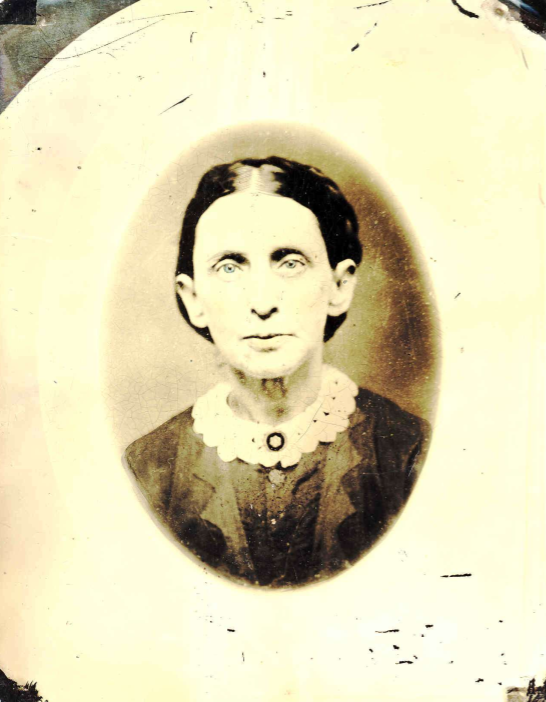
Imagine stepping back in time and meeting the John Mustain family as they
arrived in McDonough County in the fall of 1832. It would have been quite a
sight. John and his wife, Elizabeth, were traveling west with nine children,
including 6-month-old George.
According to S. J. Clarke’s History of McDonough County, John was “a large
portly man, of good appearance, pleasant and agreeable.” Their son, Thomas
A. Mustain, stood over six feet tall and weighed about 215 pounds. The
Mustains were a family that did not go unnoticed.
John was born in Pittsylvania County, Virginia, in 1782. His early life was
diƯicult. Orphaned at the age of four, he was apprenticed to a hatter. After
several years, he decided carpentry was a better fit and spent more than thirty
years working in that trade.
Records show that John began purchasing land in Virginia as early as 1812. By
1832, however, he and Elizabeth had decided to seek a new life in the West.
They sold their property, including land Elizabeth had inherited from her
father, Nathan Glenn, and headed for Illinois.
After arriving in McDonough County, John purchased 400 acres near Job’s
Settlement for $1.25 per acre. Even after buying the land, he still had several
hundred dollars in gold coins from a bank in Lynchburg, Virginia. The problem
was that few local residents knew the value of the coins and were reluctant to
accept them.
Someone suggested that Mustain speak with James M. Campbell in Macomb.
Riding into town, Mustain stopped a man and asked where he could find the
Circuit Clerk.
“I am the Circuit Clerk,” the man replied.
Embarrassed, Mustain explained that he was actually looking for the County
Clerk.
“I am the County Clerk,” came the answer.
Then Mustain asked who served as Postmaster.
“You are talking to him,” the man replied.
The man was James M. Campbell.
After hearing Mustain’s situation, Campbell oƯered to take the gold to St.
Louis on his next trip, exchange it, and extend credit so the family could
purchase supplies and get settled. The act of trust marked the beginning of a
lifelong friendship. Campbell later said there was no man he respected more
than John Mustain.
John and Elizabeth raised a large family. Their children included William D.
“W.D.,” Daniel C., Thomas A., Nathan Glenn, Jane (Mrs. Solomon Howard),
John Terry “J.T.,” Elizabeth A. (Mrs. Archibald Owen), James Alexander “J.A.,”
George W., and Gilly or Gella, who was born in McDonough County in 1834.
Elizabeth died in 1863 during the Civil War. John followed in 1869. By that time,
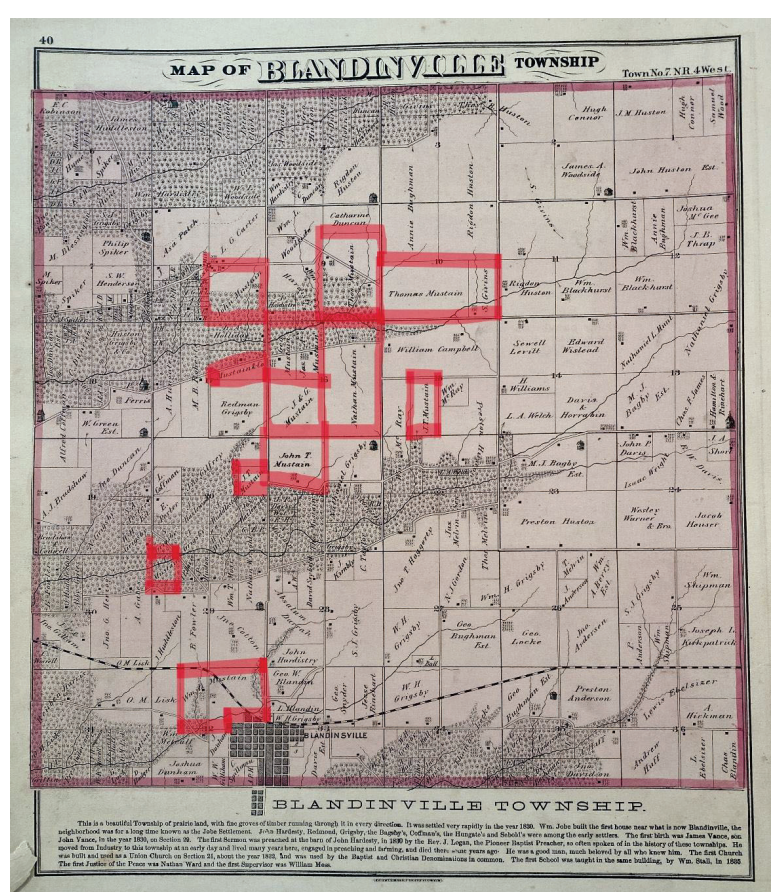
the family had become one of the county’s largest landowners. In 1871, the
Mustains owned more than 3,800 acres in the Sciota and Blandinsville
townships and had more than sixty grandchildren.
Despite their success, the Mustains left little record of civic involvement. No
sketches of their farms appeared in the 1871 McDonough County Atlas. The
family were Democrats in politics but seem to have devoted most of their
attention to farming and raising their families.
Today, the Mustain name can still be found in cemeteries throughout
McDonough County, including the Mustain Family Cemetery, Glade City
Cemetery, and Hillsborough Cemetery. Yet time has a way of changing things.
A look at the modern McDonough County plat book reveals that only one
person bearing the Mustain name still owns a small piece of land in the
county their family helped settle nearly two centuries ago.
Pioneers of the Past is furnished by Julie L. Terstriep, of the McDonough
County Genealogical Society, facebook.com/mcdcgs. For more Pioneers of
the Past, go to https://www.mcdcgs.com/pioneers-of-the-past/
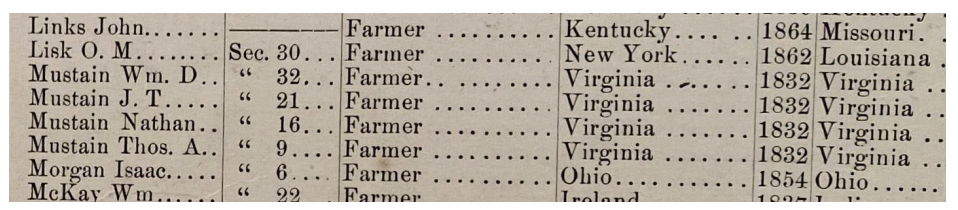
County, showing the year the Mustain brothers came to McDonough County
and from what state.
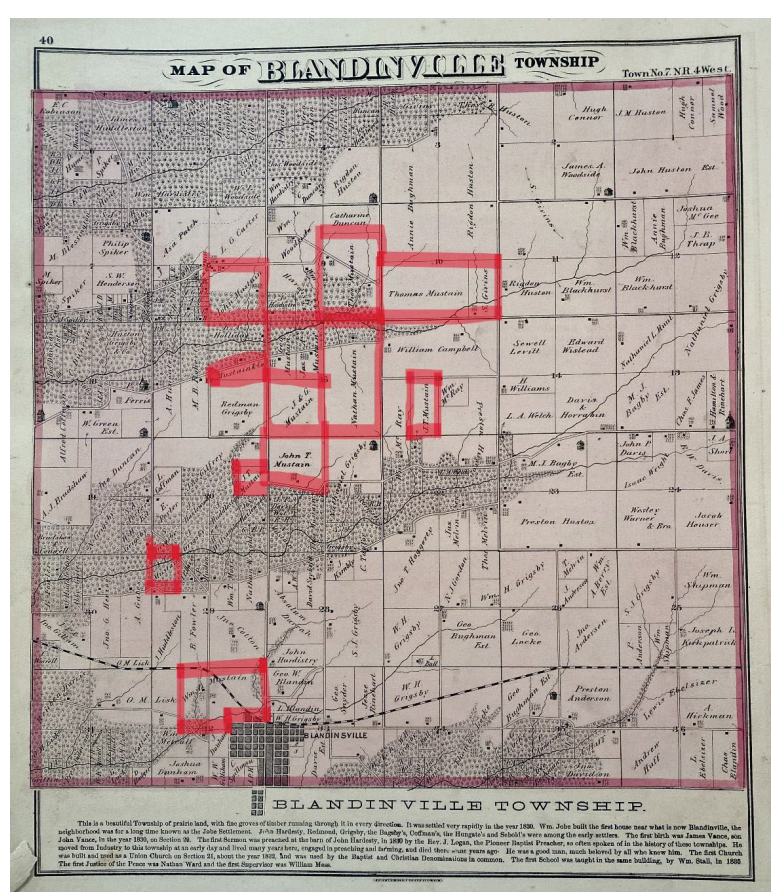
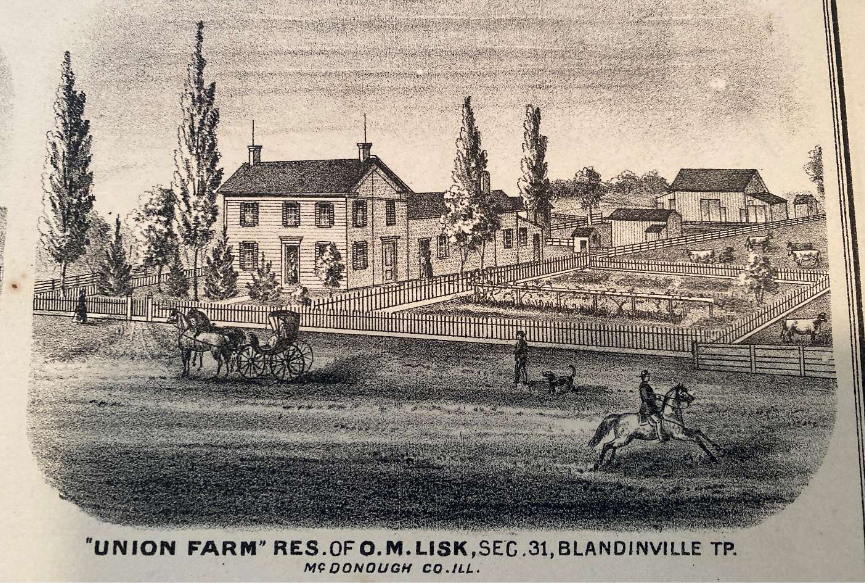
Township.
(in red) 1871 land holdings of the Mustain Family in Sciota Township.