Riggs Pennington #6


Riggs Pennington was born in 1787, most likely in North Carolina—though Tennessee and
Kentucky both make their claim, which fits the restless pattern of his life. He was the son of
Timothy Pennington and Susannah Riggs, and if there was ever a man shaped by westward
movement, it was Riggs.


In 1815, while in Barren County, Kentucky, he married Joanna Catherine Osborne—possibly
his cousin, as families often intertwined on the frontier. Together they began a life that
would be marked not by settling down, but by pushing forward.


Riggs and Joanna would have twelve children, and it sometimes seems their children’s
birthplaces mark a trail across the map. Their daughter Matilda, later Matilda Dupuy, was
born in 1817—records place her in Kentucky, Indiana, or Illinois. Another daughter, Mary
Eliza Jane, was born in Illinois in September 1818. By 1819, Riggs, just thirty-two years old,
purchased 160 acres in Wayne County, Illinois, at two dollars an acre. That same year
Joanna gave birth to their son Elijah.


The 1820 census places the family in Franklin County, Illinois, where sons Elihu and
William may have been born. But Riggs was not the sort of man to stay long in one place.
Like many early pioneers, he opened ground, made improvements, and then looked toward
the next horizon.


In the spring of 1826, he brought his growing family north into what was then raw country—
McDonough County, Illinois. They settled on the northeast quarter of Section 24 in Industry
Township, alongside William Carter and members of the Osborne clan. That February, their
son Elisha L. Pennington was born, making the family among the very first white settlers to
enter the county. Still, true to form, they did not remain.


By 1830, Riggs and Joanna had moved again, this time to Knox County, Illinois. There, Riggs
helped organize the young county, serving as one of its first commissioners along with
Philip Hash and Charles Hansford—so respected a man that Riggs later named a son for
him. When the Black Hawk War broke out in 1831–1832, Riggs answered the call to serve,
alongside his son Stephen. Another son, Asa, was born in Knox County in 1834.


The Pennington household was a large one. In addition to the children already mentioned
were Julia, Hansford, Lydia (who later married Whitaker), and John Wesley, among others.
Their family story reads like a roll call of frontier Illinois.


Then came Texas.


After the Republic of Texas was established, Riggs once again felt the pull of new
opportunity. In 1837, he moved his family south to Fannin County, Texas. By 1850 and 1860,
the family was firmly planted in Brenham, Washington County. At last, it seems, Riggs had
found a place to stay. His descendants would become respected citizens there—authors,
attorneys, and community leaders.


Riggs Pennington died in Brenham in 1869 or 1870 at about eighty-three years of age. The
1870 Mortality Schedule lists him simply as a farmer. Cause of death: asthma. After a
lifetime spent carving homes from the frontier and following the edge of settlement
westward, it was a quiet ending for a man who had rarely stood still.

John Wilson and Martha Vance – #5

Every county has its “firsts”—births, marriages, and deaths. In McDonough County, the first recorded marriage was that of John Wilson and Martha Vance.

John Martin Wilson was born in 1806 in Jackson County, Tennessee, the son of Hugh Sr. and Susan (Skiles) Wilson. He came to the area with other pioneer families seeking land and opportunity.

Martha Ramsey Vance, born between 1804 and 1806, was the daughter of James Sr. and Margaret (Reno/Reneau) Vance. James was the “third white man to settle in the county and for a time the only white man living here as the two earlier settlers had moved on,” according to an historical article in the Industry Press written by his grandson. Vance also helped lay out the city of Macomb in 1831 and served as one of the first county commissioners. He was also the first postmaster of Industry.

John and Martha were married by Baptist minister, Rev. John A. Logan on Thursday, October 30, 1828, in what is now southeastern Industry Township. At the time, McDonough County had not yet been formally organized, so their marriage license was filed in nearby Schuyler County, which still held jurisdiction over the region.

A charming detail of the wedding survived through family memory. In 1938, their grandson, Lawrence D. Wilhelm, told the Industry Press that on their wedding day the couple walked barefoot most of the way to the fort, carrying their shoes and stockings. They put them on for the ceremony, then took them off again for the walk home—a simple solution in a place where such items were hard to come by.

The couple first lived in a log house constructed by John on section 23 of Industry Township. In this home their six sons and six daughters were raised. By 1854, the Wilsons left their log cabin for a new frame house built about a quarter mile away on the same section. The new house was built of black walnut lumber. In 1938, it was still standing and was being used as a barn.

In 1878, John Wilson shared with S. J. Clarke his life story as the latter wrote Clark’s History of McDonough County. In the interview Wilson shared how he began farming with one horse and three cows and broke his land with a borrowed plow. “After this, I made a wagon myself entirely of wood, the wheels of which were made solid and hewed out of a large tree. There being no iron about it, I had to keep it well-soaped to keep it from being set on fire by the friction,” shared Wilson.

Wilson also shared that he had raised large fields of cotton and flax, from which his family made all their goods. As a young man, while his wife sat spinning at night and weaving cloth, he lay near the hearth learning how to read and write from what he called a “United States Spelling and Primer Book.”

Meat for the table often came from hunting. Wilson said he hunted with an “old flintlock gun” he had traded for at the time he came to the county – the gun being old and having done such service even when he traded for it.

Wilson named many of the wild animals found near their farm including wolf, wildcat, fox, lynx, badgers and even black bear. Wilson often hunted with his dogs or a neighbor’s hounds to bring meat to the table, but on one occasion, he found a fawn left by its mother, which he adopted as his pet.

John and Martha shared 53 years of married life. Martha passed away first, and John followed her five years later. They raised twelve children—six daughters and six sons—and helped anchor one of the county’s earliest families. John, Martha, and their first seven children now rest in Vance Cemetery in Industry Township.

Their children were: Elizabeth Wilson (Mrs. John Young), Mary Vance Wilson (Mrs. William Springer), Hugh Wilson, Jr. (married Harriet Hobart), Sarah Wilson (Mrs. Collin Cordell) , James Vance Wilson (married Permelia Adkisson and then her sister, Clarice Adkisson), Susannah A. Wilson (Mrs. Andrew Jackson Wilhelm), William Vance Wilson (married Elizabeth Wilhelm), Christopher Columbus Wilson (married Elizabeth Reno), twins – Rufus Ramsey Wilson (married Martha Hardrader) and Lewis Ramsey Wilson ( married Emma Merrick), Margaret Ramsey Vance Wilson (Mrs. James Pleasant Shannon), and Martha R. Wilson (Mrs. William Ross Reed).

Twins Rufus and Lewis Wilson both served in the Civil War and made it through the war without a scratch to return to the area.

©Pioneers of the Past is furnished by Julie L. Terstriep, of the McDonough County Genealogical Society, facebook.com/mcdcgs, https://www.mcdcgs.com/pioneers-of-the-past/
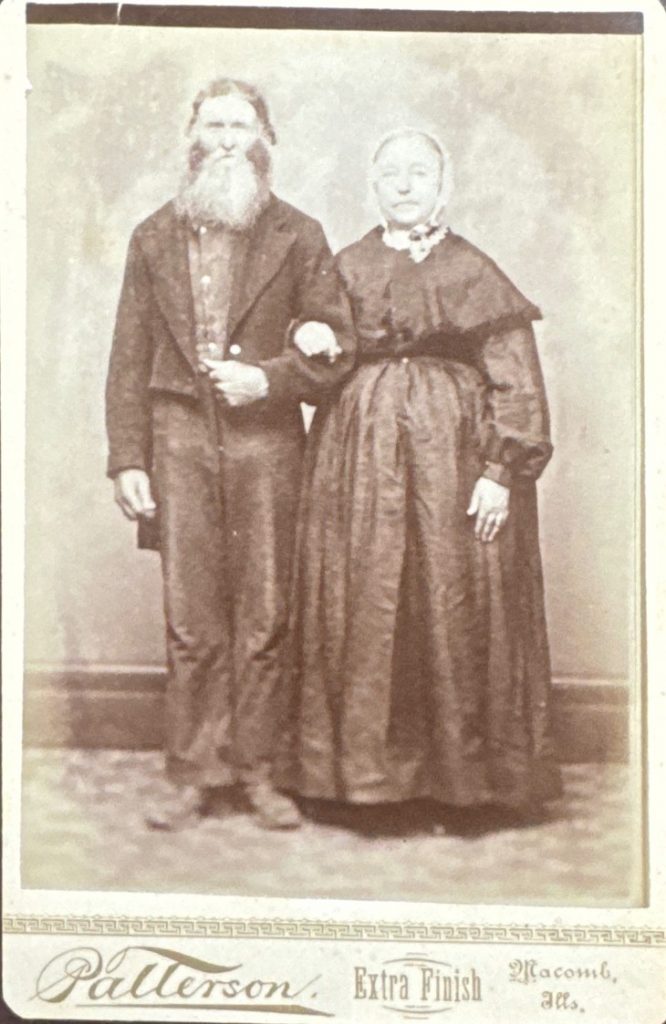
John Martin Wilson and Martha Ramsey Vance Wilson in the late 1870s near their golden wedding anniversary.

Camp Creek Settlement – #4

Just months after William Pennington settled Pennington’s Point, William Osborne camped in the summer of 1828 along a creek on the border of Scotland and Industry townships. The area became known as Camp Creek, named for the creek itself. Osborne had migrated from Kentucky with the Pennington and Carter families. His daughter Rebecca, who married William Pennington in 1820 in Indiana, also came to McDonough County with her family.
The 1907 Historical Encyclopedia of Illinois – McDonough County described the area as having large timber along the creek, with hazel brush, crab apple, and plum trees covering the surrounding land. Today, this site is home to Camp Creek Cemetery.
William Osborne spent the remainder of his life in McDonough County and died on September 14, 1838, as the area began to develop. He left ten children; seven remained in the county as adults and married into other founding families, including the Russells, Joneses, Mayfields, and Cockerhams.

William Osborne was born one year to the date after the signing of the Declaration of Independence (4 Jul 1777) in Virginia, the son of Robert Osborne and Anne Howard. He married Kesiah or Keziah Smith in 1800 in Ashe, North Carolina and their first child, Reebecca, was born a year later.

Their children were:
• Rebecca Osborne Pennington, Mrs. William Pennington (1801-1874)
• Nancy Osborne Ashworth, Mrs. Chesley Ashworth (1801 – ?)
• Eli Osborne (1806 – 1866) married Martha Patsy Luttrell
• Larkin S. Osborne (1808-1881) married Delilah Belyeu
• Lydia Osborne Russell, (1813-1872) Mrs. Caswell Russell
• Ruth Osborne Goodspeed, (1815-1889) Mrs. Norman Goodspeed
• Matilda Osborne Cockerham Claybaugh, (1820-1896) Mrs. Andrew J Cockerham, #2 Mrs. John Claybaugh
• Elizabeth H. Osborne Jones, (1816-1860) Mrs. Morgan Jones
• John S. Osborne, (1828-1910) married Susanna Elizabeth Osborn
• Tabitha D. Osborne Mayfield (1830-1889) Mrs. James Henry Mayfield
• Mary Osborne, no known information available

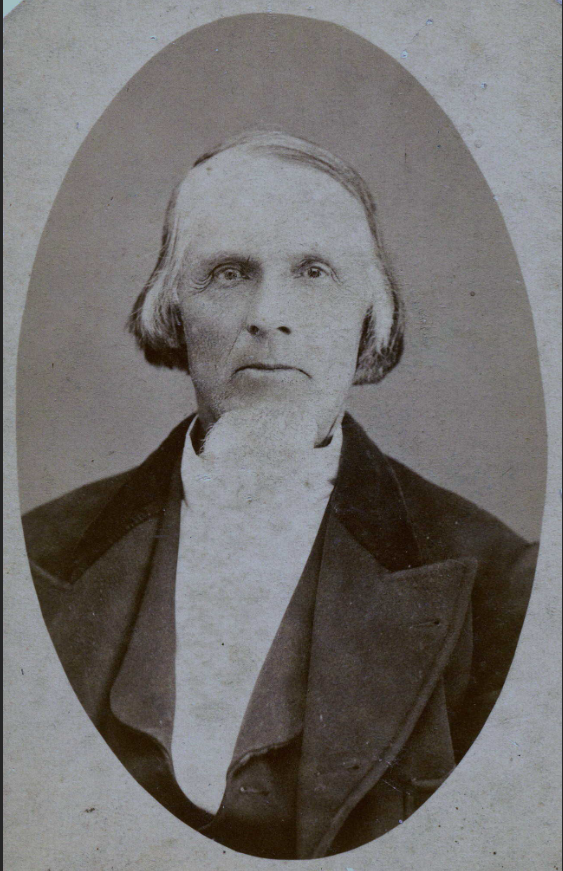
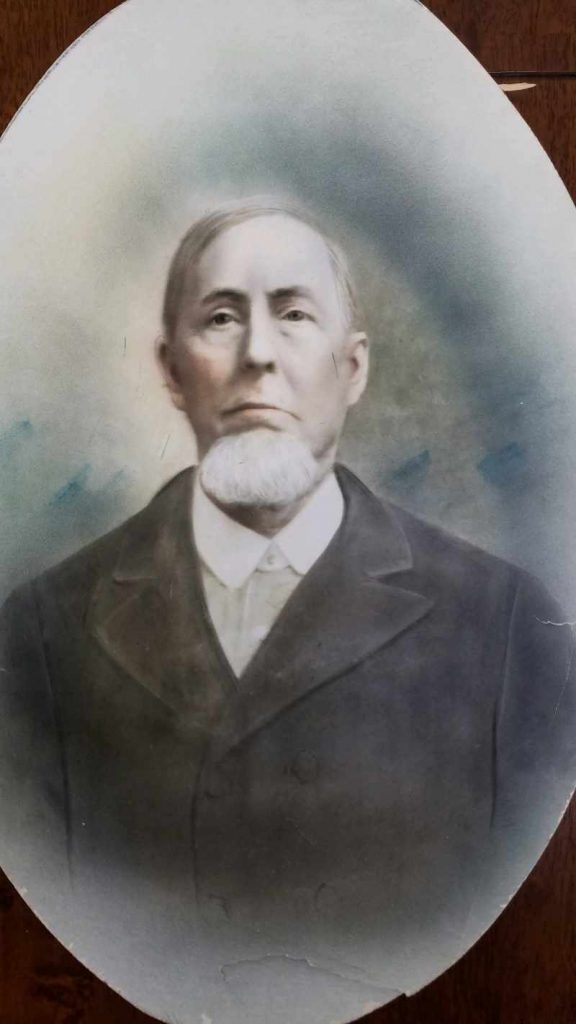
No known photographs of William Osborne exist, but images of two of his sons, Larkin and John Osborne survive.

Pioneers of the Past is furnished by Julie L. Terstriep, of the McDonough County Genealogical Society, facebook.com/mcdcgs, https://www.mcdcgs.com/pioneers-of-the-past/

Larkin Osborne, (1808 – son of William and Keziah Osborne – “founder” of Camp Creek Settlement in McDonough County.
John S. Osborne (1828-1910), son of William and Keziah Osborne

Pennington Point Settlement (#3)

The third settlement in McDonough County was established in 1828, when William Pennington erected a cabin in the southwest corner of what is now New Salem Township. William’s son, Perry Pennington, was the firstborn in the township in 1828.
The Pennington families played a major role in the county’s early settlement. Two years earlier, in 1826, Riggs Pennington and William Carter had founded Carter’s Settlement in what is now Industry Township.

Another early settler in Pennington’s Point was John Stewart Pennington (1784–1859), identified in early county histories as a cousin of William Pennington. John Stewart was the son of Richard Pennington and Hannah Boone—who was the sister of the famed frontiersman Daniel Boone.

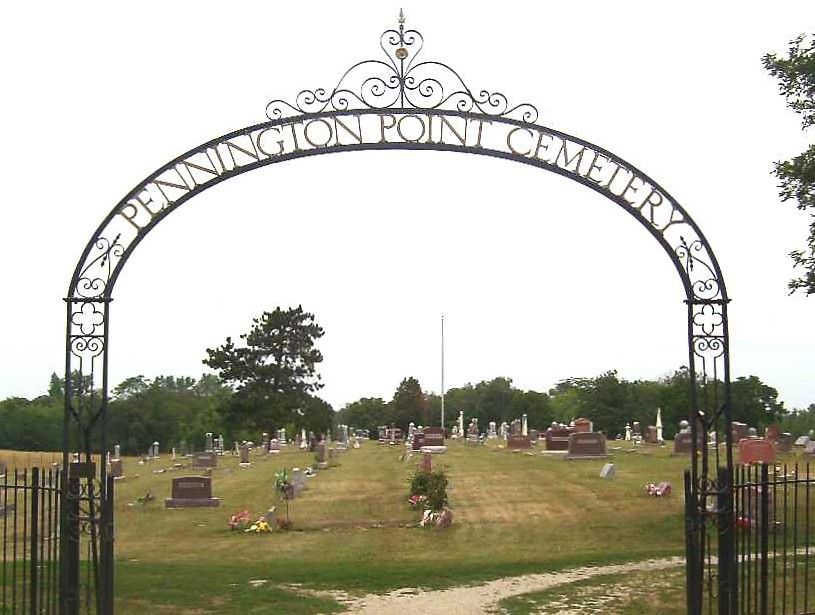
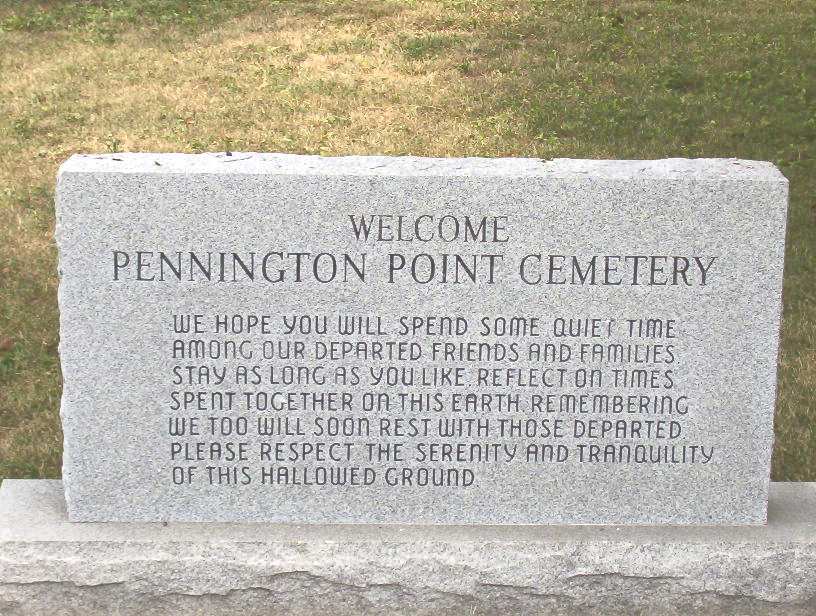
Today, Pennington Point Cemetery in New Salem Township is considered one of the county’s most picturesque rural cemeteries. Nearly 20 members of the Pennington family are buried there, with others resting in Pennington, Standard, Wilhelm, and Industry cemeteries in Industry Township; Walker Cemetery in Sciota Township; and Oakwood Cemetery in Macomb.

Pioneers of the Past by Julie L. Terstriep, of the McDonough County Genealogical Society, facebook.com/mcdcgs, https://www.mcdcgs.com/pioneers-of-the-past/


William Jobe and Job’s Settlement (#2)

At nearly the same time that Carter’s Settlement was taking shape in southeastern McDonough County, another small community was beginning to form near what is now Blandinsville. William Job(e), his brother-in-law John Vance, and Hugh Wilson were drawn to the area by its promise. Richard Dunn had camped there earlier, but by the time the 1830 Federal Census was taken, he had moved on and no longer appeared in the county.

In 1826, Job(e) and Vance chose land in Section 33 of Blandinsville Township, where they found reliable water, fertile soil, and nearby timber. There, they built their homes and began establishing permanent lives on the frontier. William Job(e) and his wife, Zilphry, arrived with four children and a newborn baby. By 1830, the census recorded Job(e)’s household at eight persons, while John Vance, living next door, counted seven in his own household.

The Job(e) family’s roots in McDonough County have endured. Descendants of William Job(e) still live in the area today, including Frank Jobe of Macomb and the late Don Jobe of Macomb, both third great-grandsons of the original settler.


Betheany Parthena Jobe Davis, daughter of Wm. Jobe.
Ephraim Perkins Jobe, son of William,(r)and his son. Ephraim was born in McDonough County.

The Carter Settlement (#1)

PIONEERS OF THE PAST #1

CARTER SETTLEMENT – WILLIAM CARTER

On January 25, 1826, the Illinois Legislature recognized the formation of McDonough County, Illinois, from land previously a part of Pike County. As we celebrate the bicentennial of McDonough County this year, the McDonough County Genealogical Society would like to introduce you to some of the pioneers of our past.

Each week, we will share information and hopefully some pictures of those who came to this frontier to establish communities. Some of the columns will spotlight people, and a few will spotlight villages and towns you may not know existed.

We are open to suggestions for those you feel deserve recognition, and if you have any photos to share, we would love to hear from you. Please send them to Julie.Terstriep@gmail.com.

McDonough County, Illinois, was established from the War of 1812 Military Tract of lands. Soldiers were promised land for their service. Many collected their land warrant and turned around to sell them immediately, having no interest in moving from the East Coast to the frontier. Although Native Americans were the first settlers in this area, the first documented settlers were either William Carter and Riggs Pennington in the early 1820s in the southern part of the county, or Richard Dunn and William Job in the northwest part of the county.

This week, we will spotlight William Carter. Carter came to the area before 1826 and established a settlement in what would later become Section 26 of Industry Township [south and slightly east of Industry, ½ mile from Highway 67]. The settlers who followed Carter built a blockhouse or log fort near Carter’s home. The blockhouse was built to afford protection against the Native Americans, but later, soldiers in the Black Hawk War poked fun at the idea of building a blockhouse more than 200 miles from Indian country. After several years, Carter moved to Missouri.

Pioneers of the Past by Julie L. Terstriep, of the McDonough County Genealogical Society, facebook.com/mcdcgs, www.mcdcgs.com.