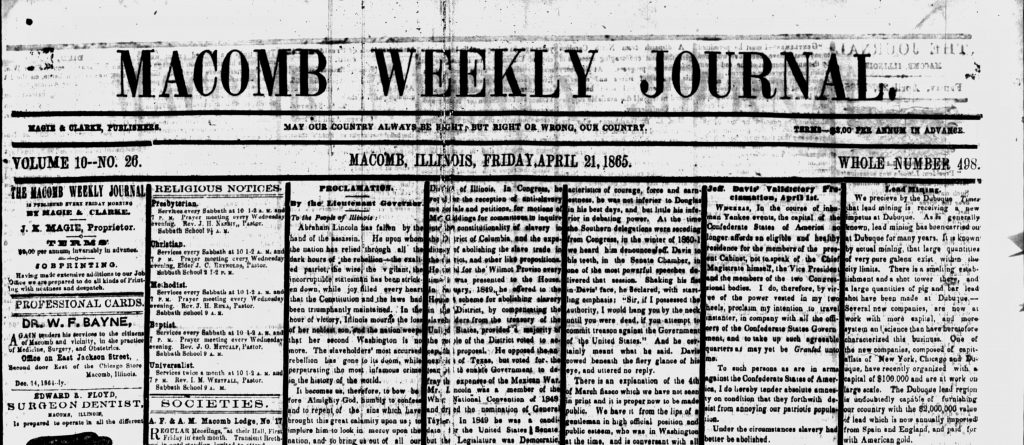
Friday, April 21, 1865, Macomb Weekly Journal
Newspapers hold a treasure trove of information about ancestors. Not only do local newspapers list births, marriages, and deaths, but frequently have land transactions and school news.
Newspapers printed in McDonough County, Illinois, or nearby, cover much of the county as well as neighboring communities in other counties. These newspapers are available FREE and can be accessed in many ways.
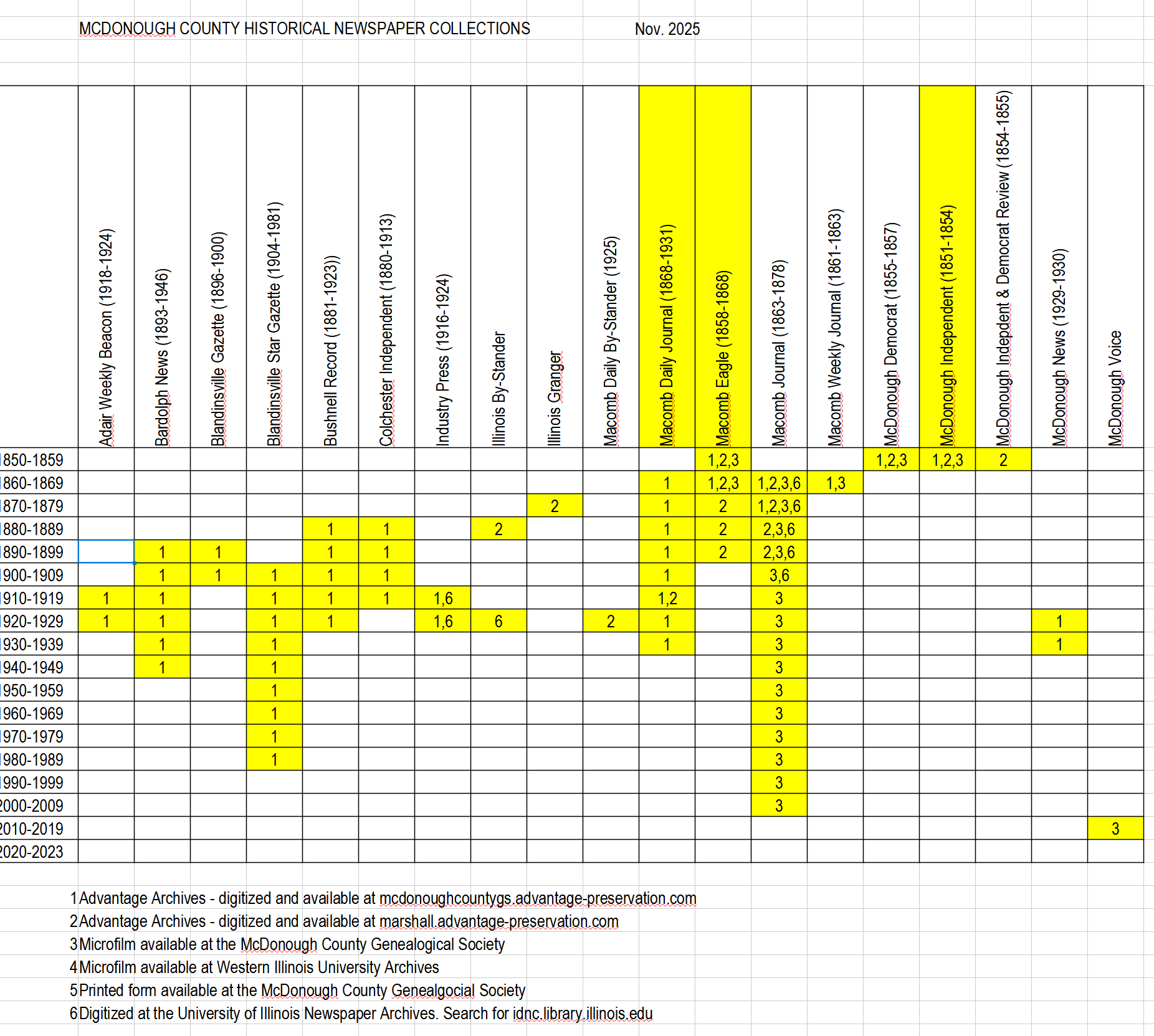
See below to download the table you see identifying where you can find different McDonough county newspapers.
Click on this -> link <- to search the following
Macomb Daily Journal
(1868-1931)
58,048 Pages
Blandinsville Star Gazette
(1904-1981)
35,244 Pages
The Bardolph News
(1893-1946)
19,876 Pages
The Bushnell Record
(1881-1923)
18,126 Pages
Colchester Independent
(1880-1913)
8,901 Pages
The Industry Press
(1916-1924)
3,594 Pages
The Adair Weekly Beacon
(1918-1924)
2,791 Pages
The Macomb Journal
(1865-1878)
2,540 Pages
The Macomb Eagle
(1858-1868)
2,020 Pages
McDonough Independent And Democratic Review
(1854-1855)
124 Pages
Blandinsville Gazette
(1896-1900)
1,272 Pages
Macomb Weekly Journal
(1861-1865)
686 Pages
McDonough Independent
(1851-1854)
626 Pages
The Macomb Daily By-Stander
(1925-1925)
617 Pages
The McDonough News
(1929-1930)
384 Pages
McDonough Democrat
(1855-1857)
245 Pages
FOR ADDITIONAL MCDONOUGH COUNTY NEWSPAPERS, USE THESE LINKS:
- Colchester District Library
- Marshall, IL Public Library
- The Macomb Journal, 1866-1890
- Macomb Eagle, 1858-1893
- The Illinois By-Stander, 1888-1888
- The Illinois Granger, 1875-1875
- The Macomb Daily By-stander, 1920-1922
- The Macomb Daily Journal , 1917-1917
- The Macomb Journal, 1861-1909
For other Illinois newspapers, try the University of Illinois Newspaper Archives. You can browse by county to find the location you need.
For information on McDonough County and surrounding areas’ contributions to the WWII effort, search THE CAMP ELLIS newspaper. Camp Ellis was a US Army Camp near Ipava, IL from 1942-1945. Many McDonough county residents, men, and women worked at the Camp. The paper is searchable by name.
This project was partially funded by a grant from the Illinois Humanities Council. The largest portion of the funding came from the Genealogy society itself.